
Zhongke Shengxuan AI Machine Hearing: Industry-leading intelligent abnormal sound detection solution
In industrial manufacturing, abnormal sound detection of products is a key link to ensure quality. However, traditional sound pressure level or spectrum analysis methods are difficult to capture subtle abnormal sounds. There are subjective biases in relying on manual judgment, and this artificial identification is not only due to Individual differences bring with them strong subjectivity, and it is impossible to achieve digitization and traceability in quality control, thus increasing errors and efficiency bottlenecks.
Core technology highlights
The AI machine hearing abnormal sound detection system launched by Zhongke Shengxuan combines the most cutting-edge machine learning and deep learning algorithms to achieve accurate identification of small abnormal sounds in industrial equipment.
Complex network and attention mechanism enhancement
The system integrates the latest complex network structure and attention mechanism. For industrial scenes with complex background noise, it can more accurately focus and identify key abnormal sounds, ensuring higher detection accuracy.
Multidimensional Audio Feature Extraction
By utilizing technologies such as Mel-Frequency Cepstral Coefficients (MFCC) and Short-Time Fourier Transform (STFT), audio signals related to human auditory characteristics are extracted, enabling multidimensional analysis of subtle abnormal sounds during the product’s operation.
Convolutional Neural Networks and Time-Series Analysis
Convolutional Neural Networks (CNN) combined with Long Short-Term Memory Networks (LSTM) effectively capture the evolving sound patterns of equipment during operation, ensuring the detection of any progressively emerging anomalies.
Self-Supervised Learning and Unsupervised Anomaly Detection
Through a self-supervised learning model, the system requires only normal operating data to automatically identify abnormal audio, completely eliminating reliance on anomalous data. By integrating autoencoder technology, the system performs real-time monitoring and anomaly detection based on sound reconstruction errors.
Anomaly Score and Autoencoder (AE)
The unsupervised learning model based on autoencoders calculates anomaly scores by reconstructing input audio signals. When the reconstruction error exceeds a set threshold, the sound is classified as anomalous. This approach is widely used in industrial scenarios for processing large volumes of data, enabling real-time monitoring and detection of abnormal sounds in equipment.
AI Machine Audition: Industry-Leading Intelligent Abnormal Sound Detection Solution
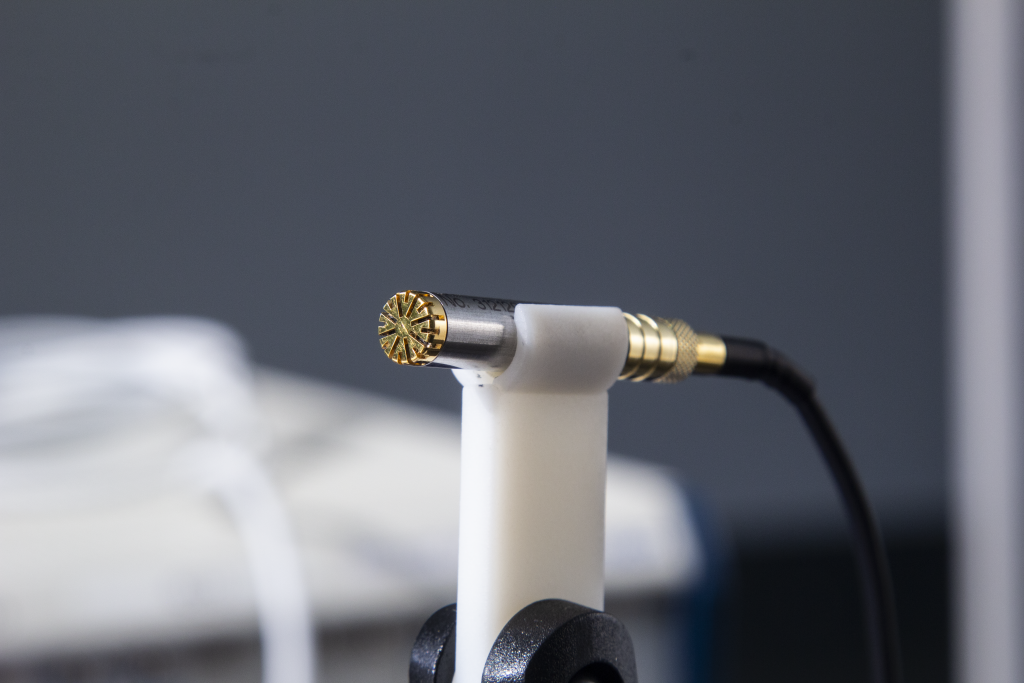
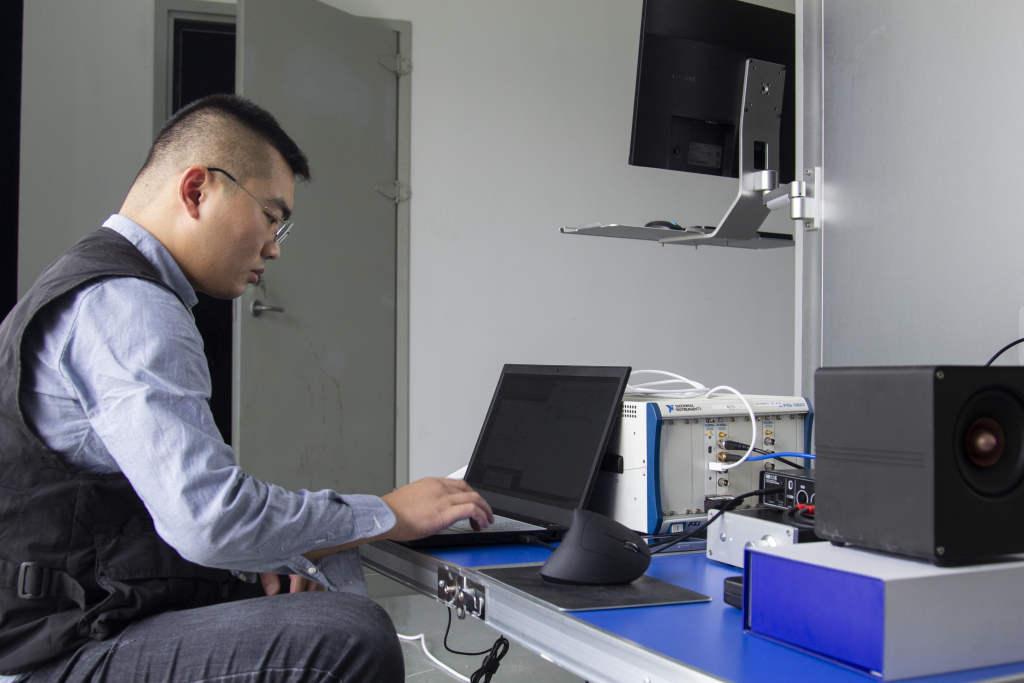
场景应用
Automotive Components
The noise test chamber is primarily used for testing noise, vibration, and NVH (Noise, Vibration, and Harshness) in automotive components. Tested products include engines, automotive seat drives, displays, actuators, air conditioning systems, and more. With the noise test chamber, automotive manufacturers can effectively control and optimize noise levels during the design and development phases, enhancing the overall quality of the vehicle and improving the user experience.
3C Electronics Industry
The noise test chamber is primarily used for testing the noise, vibration, sound pressure levels, and other acoustic properties of 3C (Computer, Communication, and Consumer electronics) products. Tested products include smartphones, headphones, speakers, computer fans, tablets, miniature motors, and more. With the noise test chamber, 3C electronics manufacturers can effectively monitor and control product noise, ensuring competitiveness in the market and high levels of user satisfaction.
Medical Devices
The noise test chamber is primarily used for testing the noise, abnormal sounds, and sound quality of medical devices. Tested products include ventilators, dental equipment, surgical machinery, monitors, and more. With the noise test chamber, medical device manufacturers can ensure their products do not generate excessive noise during use, thereby enhancing patient comfort and improving the reliability of the equipment.
Home Appliances
The noise test chamber is primarily used for testing noise, vibration, and sound quality in home appliances. Tested products include air conditioners, vacuum cleaners, refrigerators, washing machines, and more. With the noise test chamber, home appliance manufacturers can effectively control product noise, ensuring competitiveness in the market and enhancing user satisfaction.
 Chinese
  Thai
Thai